> ## Documentation Index
> Fetch the complete documentation index at: https://ngquct-feat-saved-query-version-control.mintlify.site/llms.txt
> Use this file to discover all available pages before exploring further.
# SQLite
> Open and query SQLite database files directly, no server needed
Point the connection at a file that does not exist yet and it is created on connect, so a scratch database costs one filename and one click.
## Quick setup
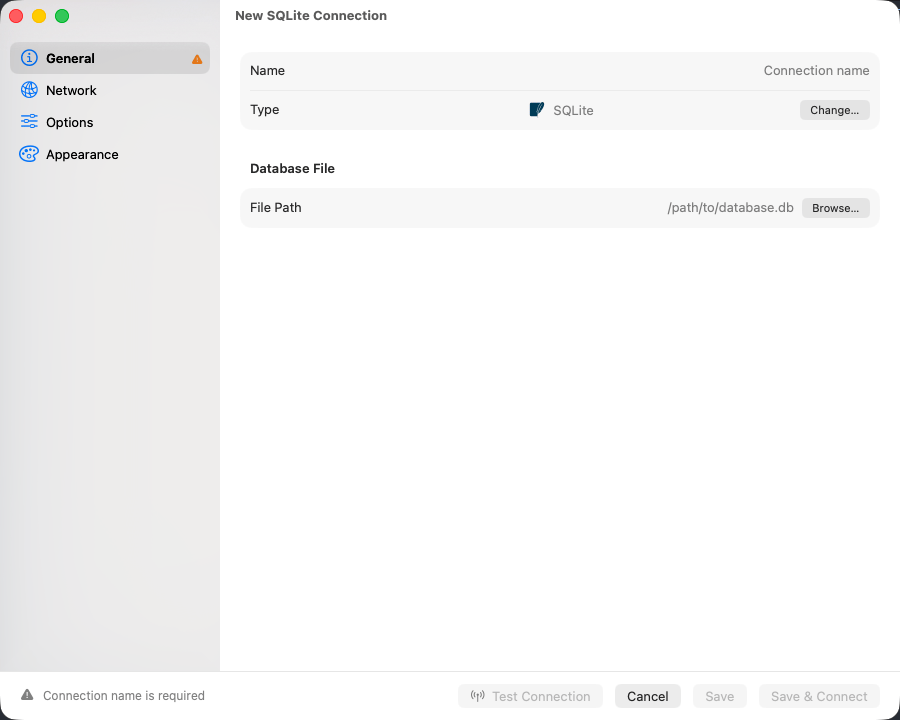
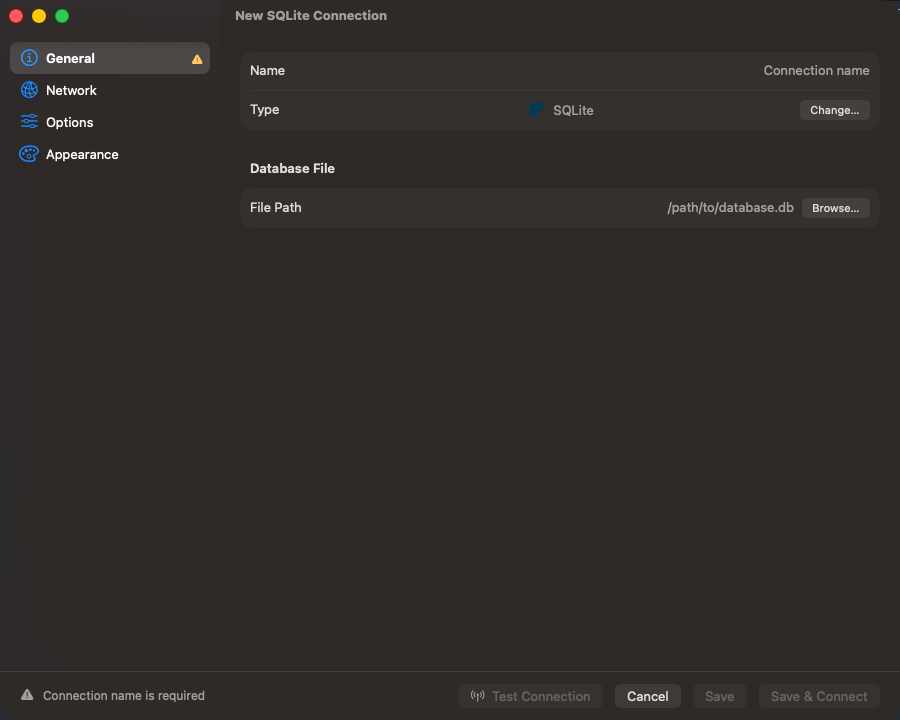
Click **New Connection…**, select **SQLite**, pick the file with **Browse…**, and click **Save & Connect**. There is no host, port, or credential to fill in. The driver ships inside TablePro with its own SQLite 3.53.4, whatever macOS version you run, so there is no server version to match.
`.db`, `.db3`, `.s3db`, `.sl3`, `.sqlite`, `.sqlite3`, and `.sqlitedb` files list TablePro under Finder's **Open With**, as an alternate handler rather than the default one. To make a double-click open them here, select one in Finder, press `Cmd+I`, set **Open with** to TablePro, and click **Change All…**.
A database saved under some other name still opens. Drag it onto a TablePro window, pick it in **File > Open File…**, or drop it on the Dock icon, and the first sixteen bytes decide the driver: a file that starts `SQLite format 3` opens here whether it is called `store.bin`, `export`, or `data.csv`. Finder's double-click is the one route that still needs a name it knows.
 ## Common locations
| Source | Path |
| -------------- | ------------------------------------------------------------------------------------------------------------ |
| Safari history | `~/Library/Safari/History.db` |
| Photos | `~/Pictures/Photos Library.photoslibrary/database/Photos.sqlite` |
| Messages | `~/Library/Messages/chat.db` |
| Rails | `./db/development.sqlite3` |
| Django | `./db.sqlite3` |
| iOS Simulator | `~/Library/Developer/CoreSimulator/Devices//data/Containers/Data/Application//Documents/` |
The Safari, Photos, and Messages databases sit in folders macOS protects. Grant TablePro Full Disk Access in **System Settings > Privacy & Security > Full Disk Access**, then relaunch the app. Without it, opening those files fails with a permission error.
Those databases are also often locked by the app that owns them. Quit it first.
## Connection URL
```text theme={null}
sqlite:///path/to/database.db
```
See [Connection URL Reference](/connections/urls) for all parameters.
## Browsing
The sidebar lists tables and views and hides the internal `sqlite_*` tables. Each table carries its columns, constraints, indexes, foreign keys, and DDL; triggers can be read and edited.
Change the file outside TablePro and the object list reloads on its own. Rows already loaded in a tab stay until you refresh that tab.
One connection is one file, with no database to switch between, and the object list reads the main database only: a file you `ATTACH` in the editor is queryable as `alias.table` but never appears in the sidebar.
## Extensions
A database built with sqlite-vec, SpatiaLite or another loadable extension cannot be read until that extension is loaded: a statement touching its tables fails with `no such module: vec0` or `no such function: ST_AsText`.
Right-click the connection in the welcome window, choose **Edit…**, and select **Options**. A new connection from **File > New Connection…** has the same pane.
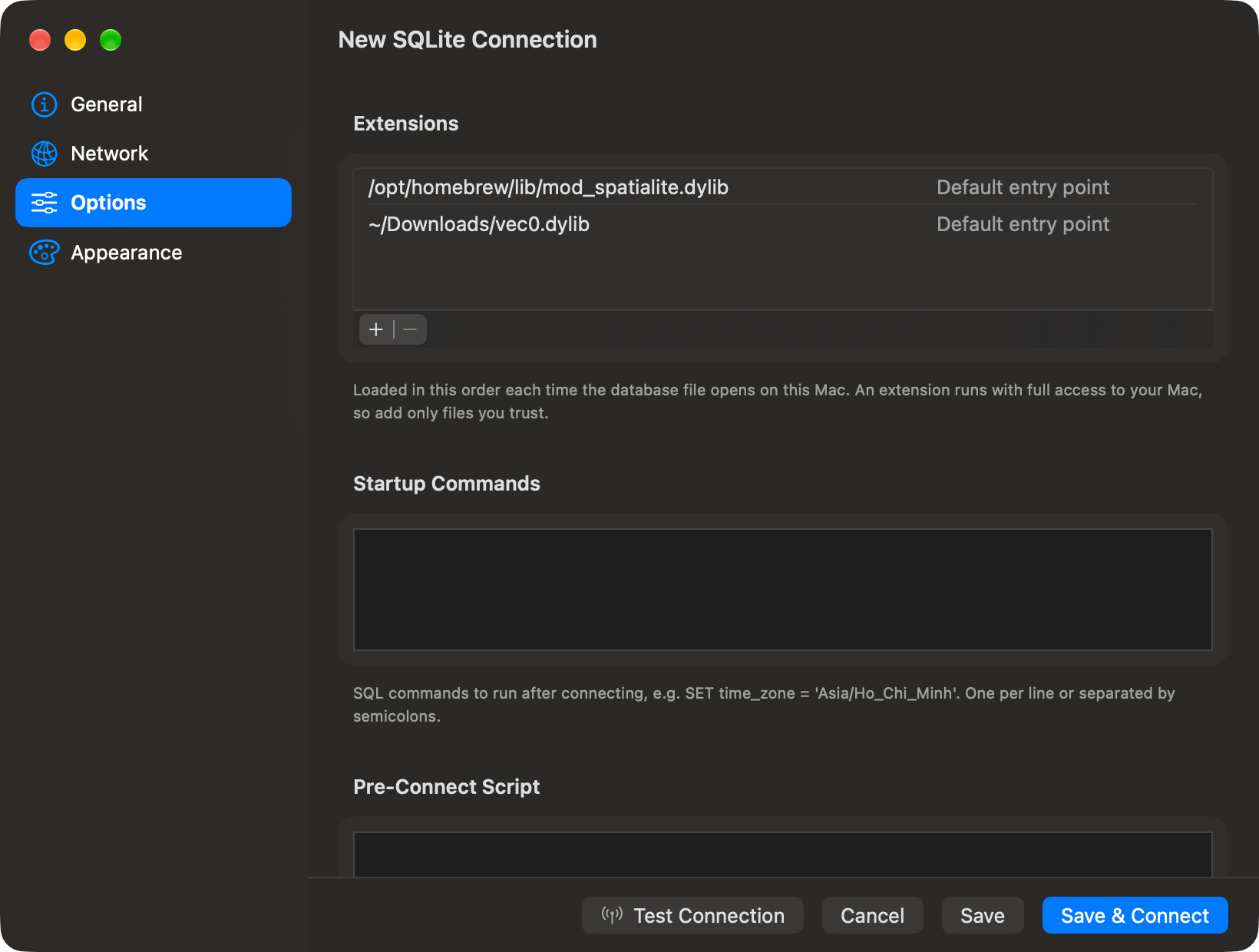
Click **+** under **Extensions** and choose the file: `vec0.dylib` from a [sqlite-vec release](https://github.com/asg017/sqlite-vec/releases), or `/opt/homebrew/lib/mod_spatialite.dylib` after `brew install libspatialite`. The file panel hides `/opt`: press `Cmd+Shift+G` in the panel and type the folder. A row's path can be edited in place afterwards, with the whole file name, `.dylib` included.
Click **Save**, then connect. The extension's functions and virtual tables answer in the editor, the sidebar and the Structure tab.
## Common locations
| Source | Path |
| -------------- | ------------------------------------------------------------------------------------------------------------ |
| Safari history | `~/Library/Safari/History.db` |
| Photos | `~/Pictures/Photos Library.photoslibrary/database/Photos.sqlite` |
| Messages | `~/Library/Messages/chat.db` |
| Rails | `./db/development.sqlite3` |
| Django | `./db.sqlite3` |
| iOS Simulator | `~/Library/Developer/CoreSimulator/Devices//data/Containers/Data/Application//Documents/` |
The Safari, Photos, and Messages databases sit in folders macOS protects. Grant TablePro Full Disk Access in **System Settings > Privacy & Security > Full Disk Access**, then relaunch the app. Without it, opening those files fails with a permission error.
Those databases are also often locked by the app that owns them. Quit it first.
## Connection URL
```text theme={null}
sqlite:///path/to/database.db
```
See [Connection URL Reference](/connections/urls) for all parameters.
## Browsing
The sidebar lists tables and views and hides the internal `sqlite_*` tables. Each table carries its columns, constraints, indexes, foreign keys, and DDL; triggers can be read and edited.
Change the file outside TablePro and the object list reloads on its own. Rows already loaded in a tab stay until you refresh that tab.
One connection is one file, with no database to switch between, and the object list reads the main database only: a file you `ATTACH` in the editor is queryable as `alias.table` but never appears in the sidebar.
## Extensions
A database built with sqlite-vec, SpatiaLite or another loadable extension cannot be read until that extension is loaded: a statement touching its tables fails with `no such module: vec0` or `no such function: ST_AsText`.
Right-click the connection in the welcome window, choose **Edit…**, and select **Options**. A new connection from **File > New Connection…** has the same pane.
Click **+** under **Extensions** and choose the file: `vec0.dylib` from a [sqlite-vec release](https://github.com/asg017/sqlite-vec/releases), or `/opt/homebrew/lib/mod_spatialite.dylib` after `brew install libspatialite`. The file panel hides `/opt`: press `Cmd+Shift+G` in the panel and type the folder. A row's path can be edited in place afterwards, with the whole file name, `.dylib` included.
Click **Save**, then connect. The extension's functions and virtual tables answer in the editor, the sidebar and the Structure tab.
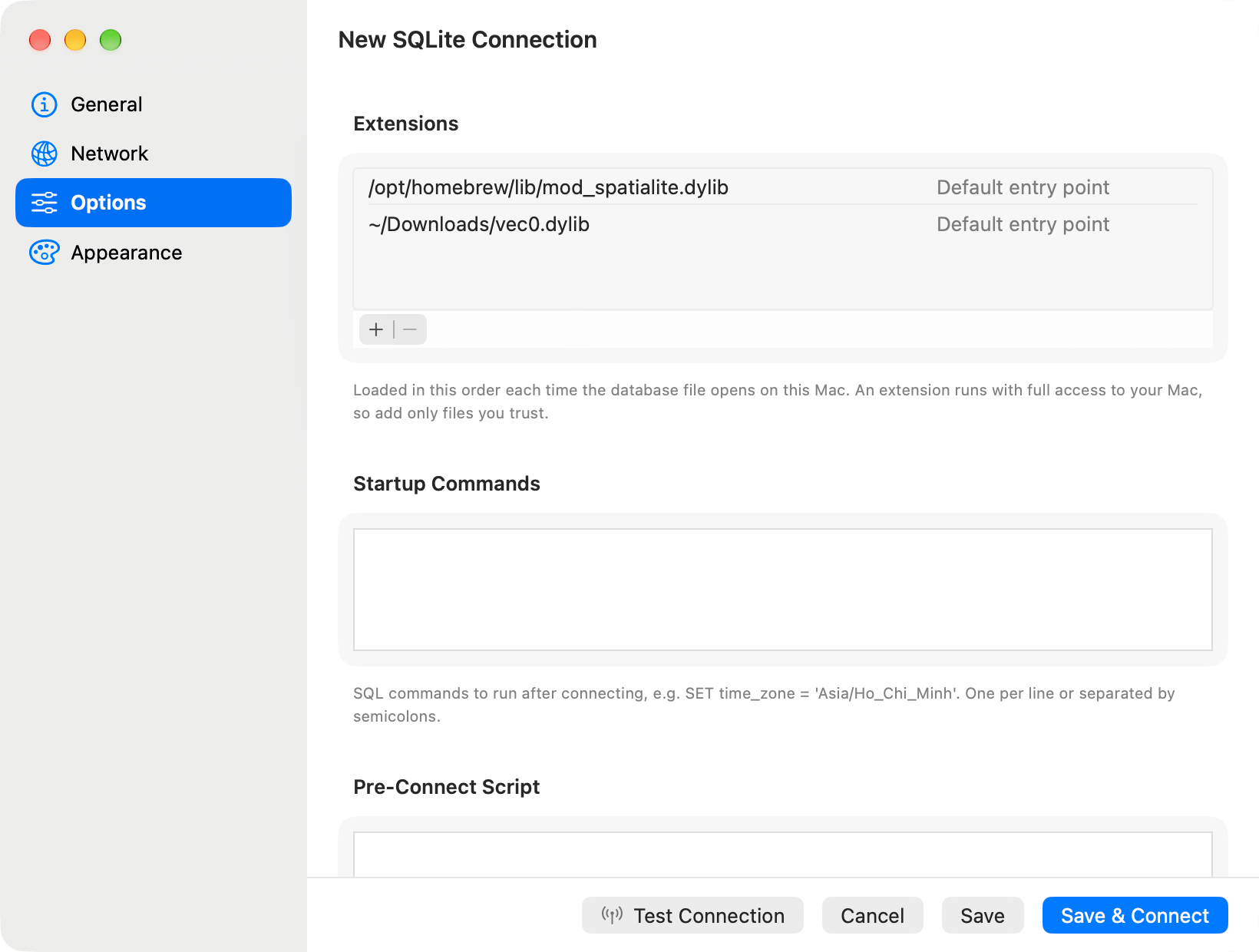
 The list loads in order every time the connection opens, Test Connection and reconnects included. Drag a row to reorder it when one extension needs another loaded first. The first file that fails stops the connect, and the connection window names the file and the reason.
Leave a row's entry point field empty for most libraries, where it reads Default entry point: SQLite derives it from the file name, `sqlite3_vec_init` for `vec0.dylib`. Fill it in for a renamed file, or to call a second function the same library exports, such as sqlite-vec's `sqlite3_vec_numpy_init`.
Only this list loads code. The `load_extension()` SQL function stays refused, so a statement in the editor, an import or an AI client cannot load a library.
An extension's functions can write files, so statements from MCP clients, AppleScript and the AI assistant may call only the functions built into SQLite on a connection that loads extensions. A vector search written with `MATCH` passes; `SELECT vec_distance_l2(a, b)` is refused with `This connection loads SQLite extensions`. Run such statements in the editor.
### A list from somewhere else
An extension runs inside TablePro with full access to your Mac. A list that arrived through iCloud, an imported connection file, a `tablepro://` link, a linked folder or the team library therefore loads nothing until you approve it: connecting shows a **Load Extensions** alert naming every file, and **Load Extensions** records the answer for that connection on this Mac. At launch such a window waits with a **Connect** button instead of asking. Files added in the form on this Mac need no approval.
### A library downloaded in a browser
macOS refuses a library that still carries the quarantine flag a browser sets, and the connect fails with `library load disallowed by system policy`. If you trust the file, clear the flag:
```bash theme={null}
xattr -d com.apple.quarantine ~/Downloads/vec0.dylib
```
A release built for the other processor fails with `mach-o file, but is an incompatible architecture`. sqlite-vec publishes separate `macos-aarch64` and `macos-x86_64` archives.
## A database on another machine
The **Remote File** pane points the connection at a database on an SSH server, and the **Open** menu beside the path decides how it is reached. **On the Server** runs your statements on the server against the live file, so reads and writes land on the database the server's own programs are using. **As a Read-Only Copy** fetches a snapshot over SFTP and opens it on this Mac, and the original is never touched.
On the Server needs `python3` on the host, which every mainstream cloud image already carries, and nothing is installed. The read-only copy needs only SFTP, and it runs at Safe Mode [**Read-Only**](/features/safe-mode#connections-that-are-always-read-only). See [Remote Database Files](/connections/remote-database-files).
## Edits that recreate the table
`ALTER TABLE` covers renaming a table or a column, adding a column, dropping a column, and from 3.53 adding or dropping a `CHECK`. Everything else the Structure tab offers is made by writing the table again: a foreign key added or removed, and a column's type, nullability or default changed.
A rebuild writes the table with the definition you asked for, copies the rows across with their rowids, puts the indexes and triggers back, and checks the rows against any new foreign key before committing. The script is shown in full and runs only when you confirm it, and everything staged in the same save travels in the same transaction.
Each column keeps its own stored text, so a `CHECK`, a `COLLATE`, a `GENERATED ALWAYS AS` and a `DEFAULT` containing a comma all survive a rebuild that touched a different column.
Changing a column's type re-reads every value in it through the new affinity. Text that looks like a number becomes one, so `'007'` in a column retyped to `INTEGER` is stored as `7`. The review sheet says so before the script runs.
A virtual table, such as an FTS5 table, cannot be recreated from what SQLite stored for it. The save is refused and names the table.
## Limitations
* Encrypted databases do not open. The driver's SQLite takes no key, and the form has nowhere to put one. Decrypt a SQLCipher file with the `sqlcipher` tool first.
* Extensions load only for a file opened on this Mac. A connection that runs **On the Server** refuses a list with `Extensions load only for a database file on this Mac`: remove the list, or open the file **As a Read-Only Copy**, which loads it.
* A column that is `INTEGER PRIMARY KEY` cannot be retyped: the key would stop generating values and start storing NULL. The save is refused and names the column.
* A primary key cannot be added, removed or moved.
## Troubleshooting
### database is locked
Another process holds a write lock. Quit the app that owns the file, or look for `-wal` and `-shm` files a crashed process left behind. The wait runs until the [query timeout](/customization/general-settings#query-timeout); **Query > Cancel Query** ends it sooner.
### unable to open database file
The path is wrong, or the folder is one you cannot read. For anything under `~/Library`, grant Full Disk Access and relaunch.
### file is not a database
The file is encrypted or is not SQLite at all. `file database.db` names what it actually is.
### no such module: …
The database has a virtual table from an extension the connection does not load, such as `vec0` from sqlite-vec. Add the library under [Extensions](#extensions).
### Could not load the extension "…".
The line under it is the reason. `There is no file at "…"` means the path is wrong or the file moved. `The file has no function named …` means the entry point SQLite derived is not in the library: type the name its documentation gives into the row's entry point field. For a download or the wrong architecture, see [A library downloaded in a browser](#a-library-downloaded-in-a-browser).
The list loads in order every time the connection opens, Test Connection and reconnects included. Drag a row to reorder it when one extension needs another loaded first. The first file that fails stops the connect, and the connection window names the file and the reason.
Leave a row's entry point field empty for most libraries, where it reads Default entry point: SQLite derives it from the file name, `sqlite3_vec_init` for `vec0.dylib`. Fill it in for a renamed file, or to call a second function the same library exports, such as sqlite-vec's `sqlite3_vec_numpy_init`.
Only this list loads code. The `load_extension()` SQL function stays refused, so a statement in the editor, an import or an AI client cannot load a library.
An extension's functions can write files, so statements from MCP clients, AppleScript and the AI assistant may call only the functions built into SQLite on a connection that loads extensions. A vector search written with `MATCH` passes; `SELECT vec_distance_l2(a, b)` is refused with `This connection loads SQLite extensions`. Run such statements in the editor.
### A list from somewhere else
An extension runs inside TablePro with full access to your Mac. A list that arrived through iCloud, an imported connection file, a `tablepro://` link, a linked folder or the team library therefore loads nothing until you approve it: connecting shows a **Load Extensions** alert naming every file, and **Load Extensions** records the answer for that connection on this Mac. At launch such a window waits with a **Connect** button instead of asking. Files added in the form on this Mac need no approval.
### A library downloaded in a browser
macOS refuses a library that still carries the quarantine flag a browser sets, and the connect fails with `library load disallowed by system policy`. If you trust the file, clear the flag:
```bash theme={null}
xattr -d com.apple.quarantine ~/Downloads/vec0.dylib
```
A release built for the other processor fails with `mach-o file, but is an incompatible architecture`. sqlite-vec publishes separate `macos-aarch64` and `macos-x86_64` archives.
## A database on another machine
The **Remote File** pane points the connection at a database on an SSH server, and the **Open** menu beside the path decides how it is reached. **On the Server** runs your statements on the server against the live file, so reads and writes land on the database the server's own programs are using. **As a Read-Only Copy** fetches a snapshot over SFTP and opens it on this Mac, and the original is never touched.
On the Server needs `python3` on the host, which every mainstream cloud image already carries, and nothing is installed. The read-only copy needs only SFTP, and it runs at Safe Mode [**Read-Only**](/features/safe-mode#connections-that-are-always-read-only). See [Remote Database Files](/connections/remote-database-files).
## Edits that recreate the table
`ALTER TABLE` covers renaming a table or a column, adding a column, dropping a column, and from 3.53 adding or dropping a `CHECK`. Everything else the Structure tab offers is made by writing the table again: a foreign key added or removed, and a column's type, nullability or default changed.
A rebuild writes the table with the definition you asked for, copies the rows across with their rowids, puts the indexes and triggers back, and checks the rows against any new foreign key before committing. The script is shown in full and runs only when you confirm it, and everything staged in the same save travels in the same transaction.
Each column keeps its own stored text, so a `CHECK`, a `COLLATE`, a `GENERATED ALWAYS AS` and a `DEFAULT` containing a comma all survive a rebuild that touched a different column.
Changing a column's type re-reads every value in it through the new affinity. Text that looks like a number becomes one, so `'007'` in a column retyped to `INTEGER` is stored as `7`. The review sheet says so before the script runs.
A virtual table, such as an FTS5 table, cannot be recreated from what SQLite stored for it. The save is refused and names the table.
## Limitations
* Encrypted databases do not open. The driver's SQLite takes no key, and the form has nowhere to put one. Decrypt a SQLCipher file with the `sqlcipher` tool first.
* Extensions load only for a file opened on this Mac. A connection that runs **On the Server** refuses a list with `Extensions load only for a database file on this Mac`: remove the list, or open the file **As a Read-Only Copy**, which loads it.
* A column that is `INTEGER PRIMARY KEY` cannot be retyped: the key would stop generating values and start storing NULL. The save is refused and names the column.
* A primary key cannot be added, removed or moved.
## Troubleshooting
### database is locked
Another process holds a write lock. Quit the app that owns the file, or look for `-wal` and `-shm` files a crashed process left behind. The wait runs until the [query timeout](/customization/general-settings#query-timeout); **Query > Cancel Query** ends it sooner.
### unable to open database file
The path is wrong, or the folder is one you cannot read. For anything under `~/Library`, grant Full Disk Access and relaunch.
### file is not a database
The file is encrypted or is not SQLite at all. `file database.db` names what it actually is.
### no such module: …
The database has a virtual table from an extension the connection does not load, such as `vec0` from sqlite-vec. Add the library under [Extensions](#extensions).
### Could not load the extension "…".
The line under it is the reason. `There is no file at "…"` means the path is wrong or the file moved. `The file has no function named …` means the entry point SQLite derived is not in the library: type the name its documentation gives into the row's entry point field. For a download or the wrong architecture, see [A library downloaded in a browser](#a-library-downloaded-in-a-browser).