> ## Documentation Index
> Fetch the complete documentation index at: https://ngquct-feat-saved-query-version-control.mintlify.site/llms.txt
> Use this file to discover all available pages before exploring further.
# iPhone and iPad
> Browse tables, run queries, and edit rows on ten database engines from a synced connection list
You need iOS 18 or later. Builds ship on their own schedule, so a feature in a Mac release note may not be on your phone yet. Your version and build are under **Settings > About**. Connections saved on a Mac come over iCloud; the rest of your Mac setup stays on the Mac.
 ## First launch
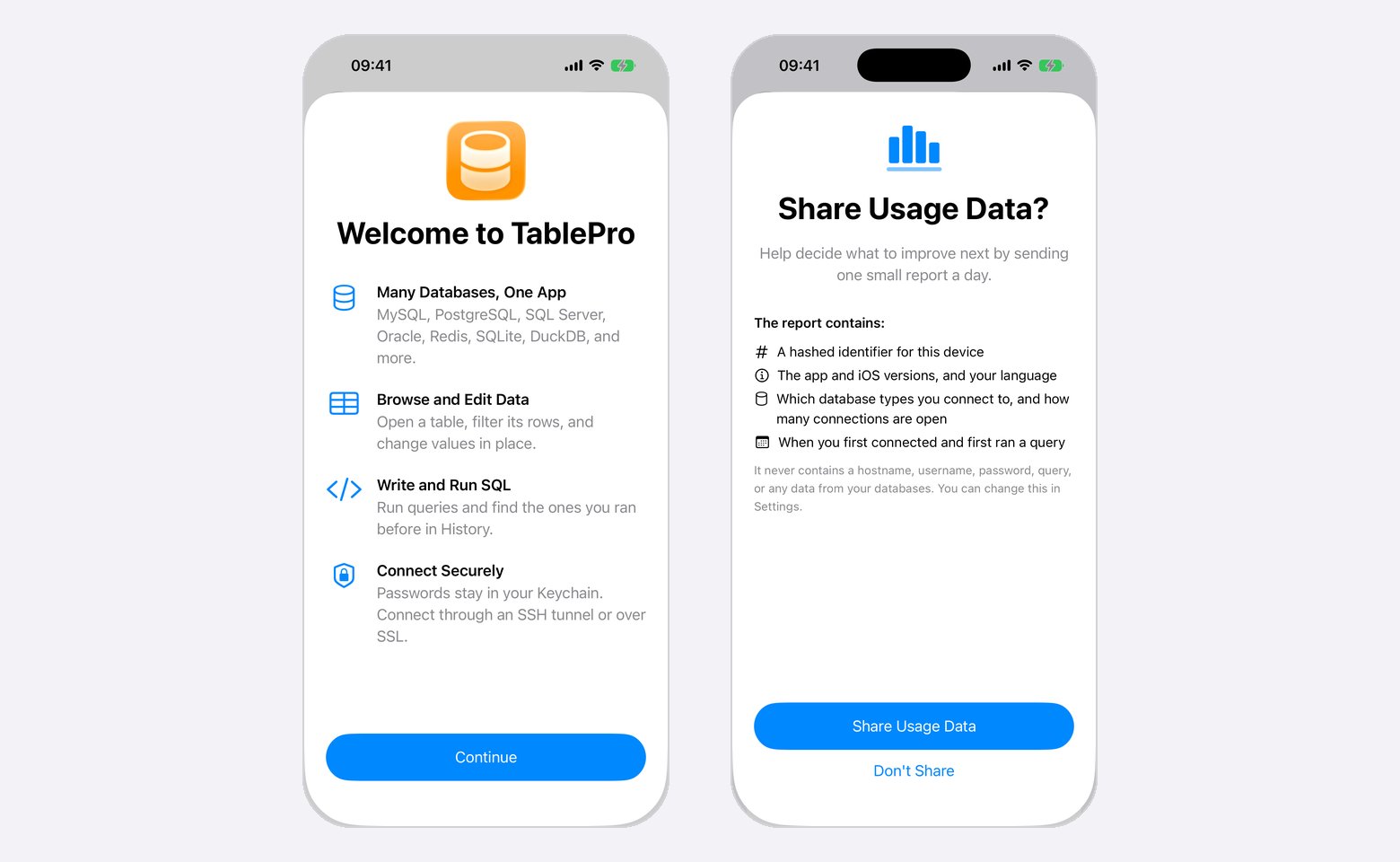
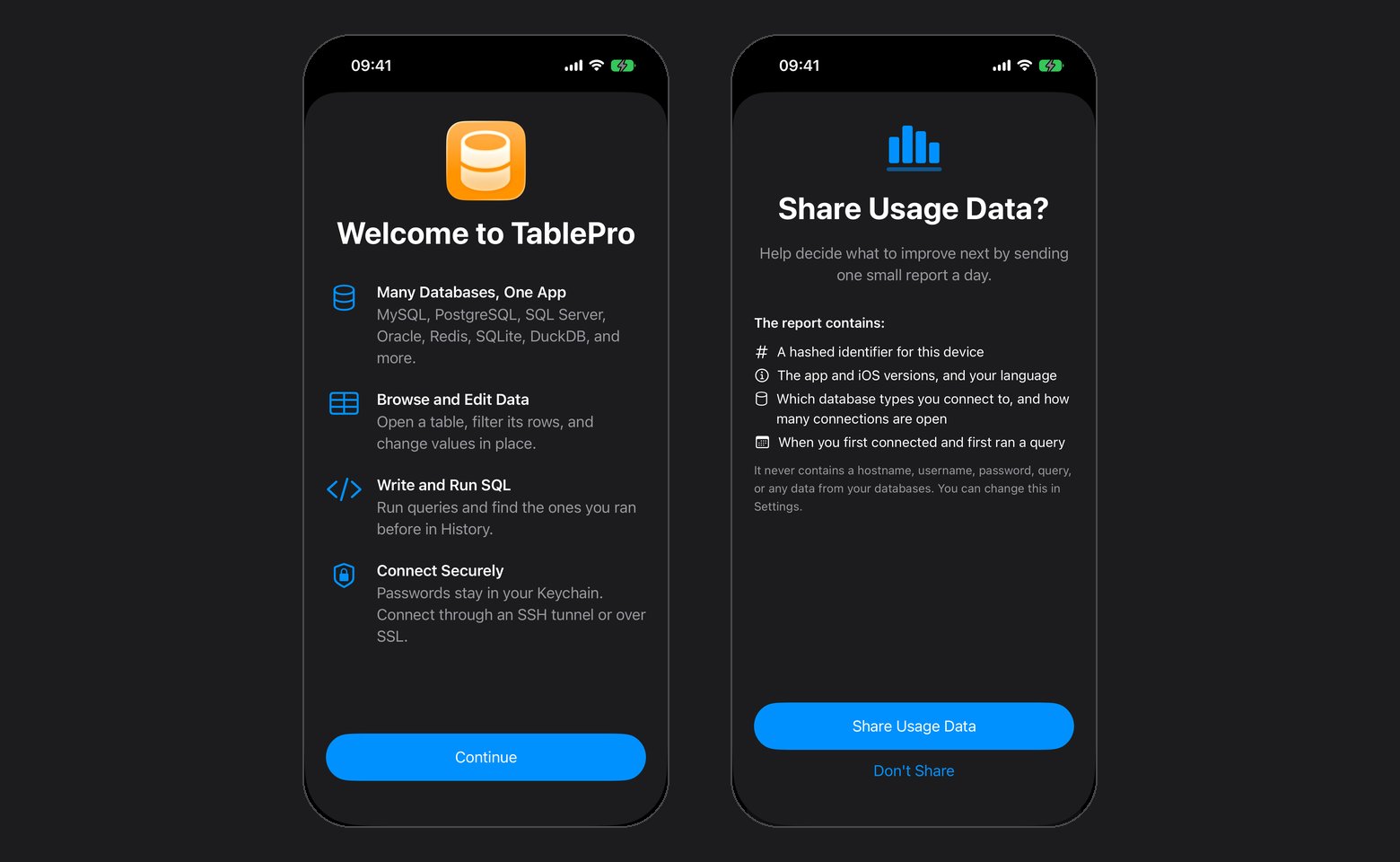
A welcome sheet lists what the app does. **Continue** leads to at most two questions, each asked once:
| Question | Shown when | If you swipe the sheet away |
| --------------------- | --------------------------------- | --------------------------- |
| **Sync with iCloud** | The device is signed in to iCloud | Sync stays off |
| **Share Usage Data?** | Always | Nothing is sent |
Both answers can change later, under **Settings > iCloud** and **Settings > Privacy**. After an update, a **What's New** sheet lists what changed, once per version.
## First launch
A welcome sheet lists what the app does. **Continue** leads to at most two questions, each asked once:
| Question | Shown when | If you swipe the sheet away |
| --------------------- | --------------------------------- | --------------------------- |
| **Sync with iCloud** | The device is signed in to iCloud | Sync stays off |
| **Share Usage Data?** | Always | Nothing is sent |
Both answers can change later, under **Settings > iCloud** and **Settings > Privacy**. After an update, a **What's New** sheet lists what changed, once per version.
 ## Supported databases
Every driver is compiled in, so there is no plugin system and nothing to install. The type picker offers these ten:
| Type | Notes |
| ----------------------- | ----------------------------------------------------------------------------- |
| **MySQL** / **MariaDB** | Port 3306 by default |
| **TiDB** | Port 4000 by default. Sequences are not listed as tables |
| **OceanBase** | Port 2881 by default. Sign in as `user@tenant` |
| **PostgreSQL** | Port 5432 by default |
| **SQL Server** | TDS, including Microsoft Entra ID sign-in on a connection synced from the Mac |
| **Oracle** | Service name or SID |
| **Redis** | Port 6379 by default |
| **SQLite** | Copies the file you pick into the app |
| **DuckDB** | A file on the device, or in-memory |
Redshift is not in the picker, but the driver is present: a Redshift connection created on the Mac connects once it syncs over.
MongoDB, ClickHouse, Cassandra, BigQuery, Spanner, Snowflake and the rest have no iOS driver. Those connections still sync and still appear in the list, but opening one fails.
## The connection list
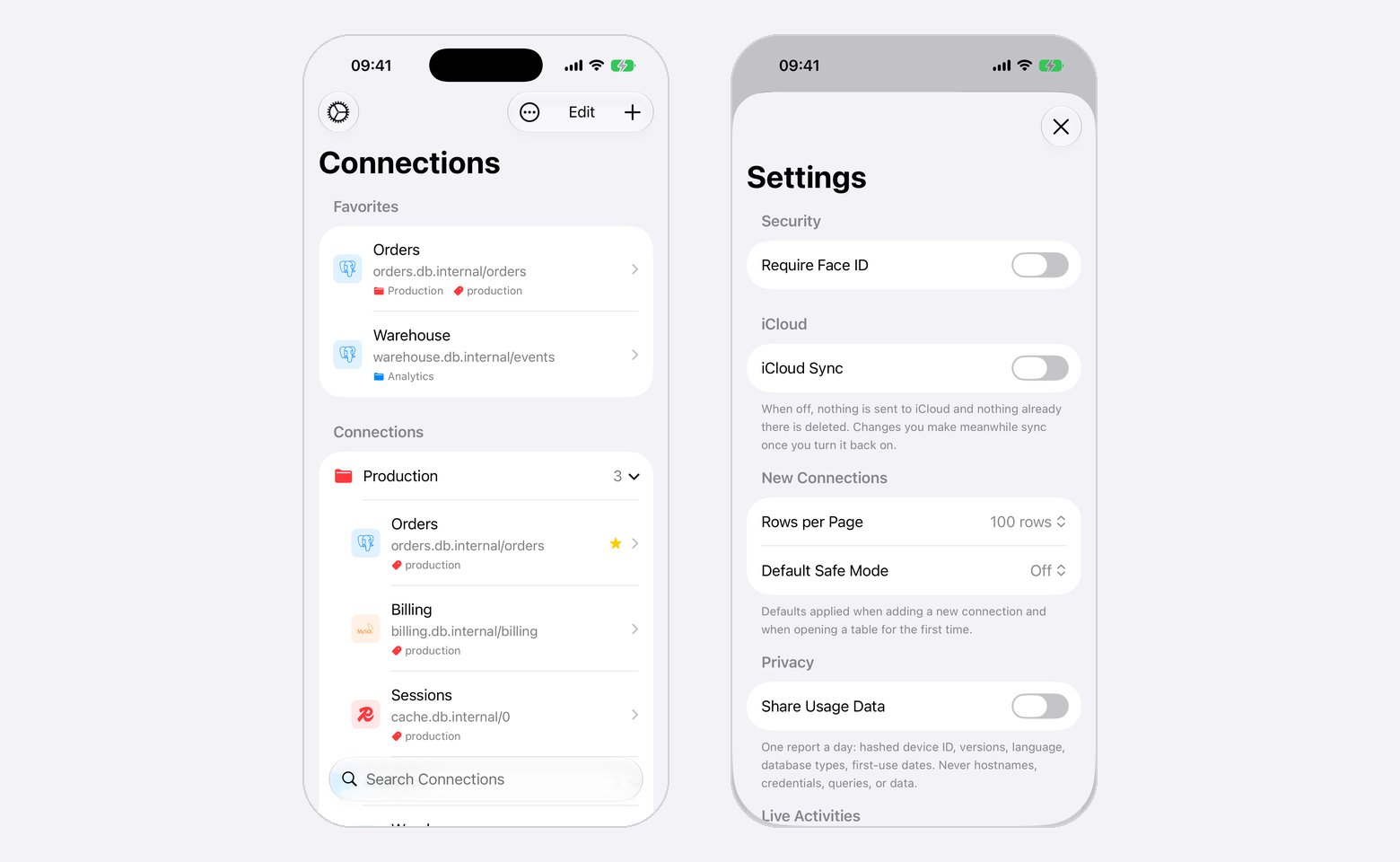
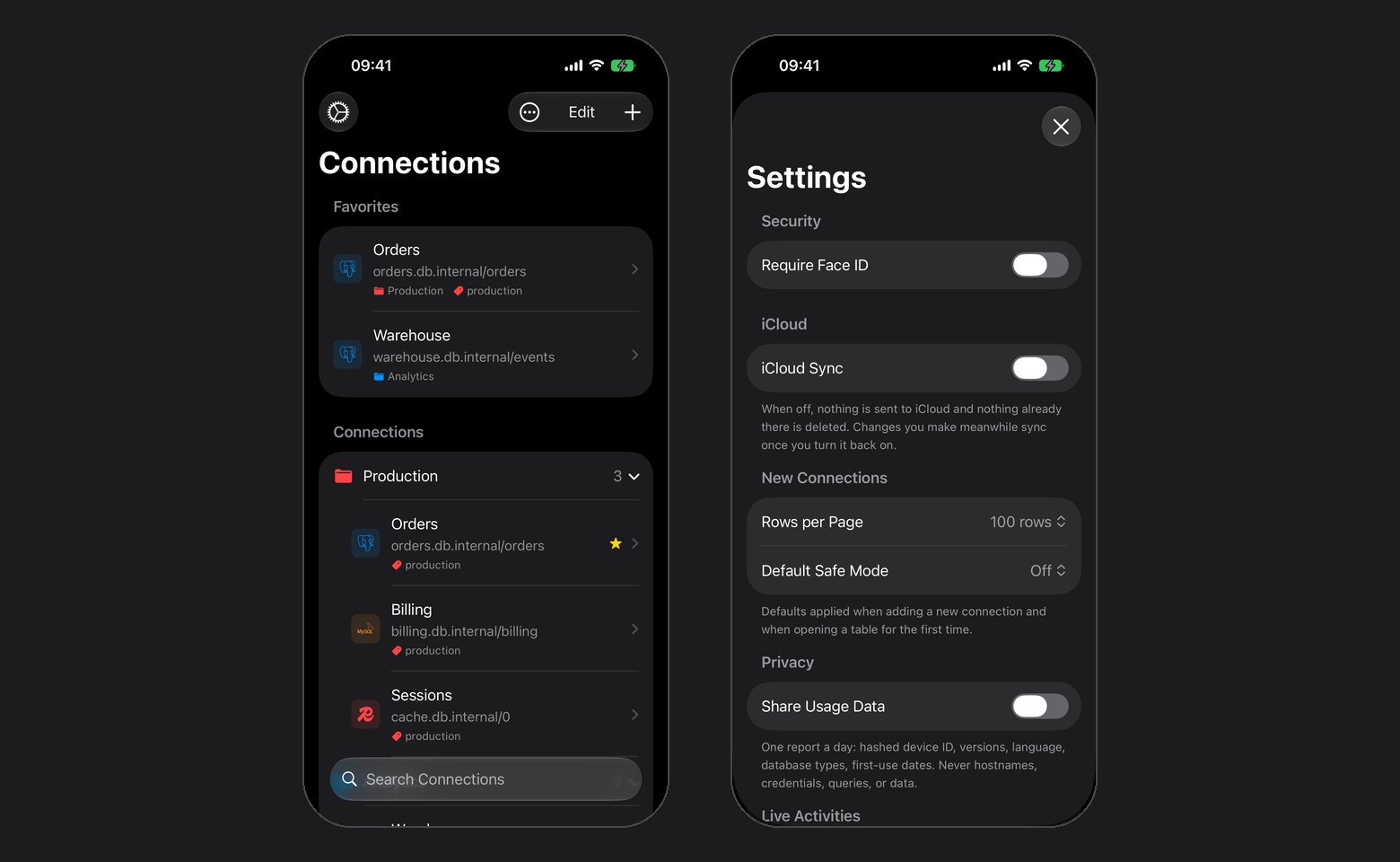
Favorites come first, then **Recent** with the five connections opened last, then your groups, nested the way the Mac nests them. The **More** menu holds **Sort By** (**Manual**, **Name**, **Database Type**, **Last Connected**), **New Group**, **Manage Tags**, **Open Sample Database**, and import and export. Type a tag's name in the search field to filter by it; with two tags or more chosen, **Match All Tags** appears in the **More** menu.
| To | Do this |
| ---------------------- | ---------------------------------------------------------------------------------------------------------------------------------------- |
| Favorite a connection | Swipe right on it, or touch and hold and choose **Add to Favorites** |
| Rename | Touch and hold, choose **Rename**, type the name, and tap **Done** |
| Move into a group | Touch and hold and choose **Move to Group**, or drag the row onto a group |
| Reorder | Tap **Edit** and drag the handles, with **Sort By** on **Manual** |
| Change several at once | Tap **Edit**, select the rows, and tap **Move**, **Favorite** or **Delete** |
| Delete | Swipe left, or touch and hold and choose **Delete** |
| Edit or delete a group | Swipe right on the group to edit it, swipe left to delete it |
| Delete a tag | Open **More > Manage Tags**, then swipe left on the tag, or touch and hold it and choose **Delete Tag**. Built-in tags cannot be deleted |
| Sync now | Pull down on the list, with iCloud Sync on |
**Duplicate** copies the saved password, SSH secrets, client certificates and file access along with the settings. Recent and the sort order stay on the device.
A connection, group or tag form with unsaved changes stays open when swiped down, and **Cancel** asks before it discards them.
## The sample database
**Open Sample Database** sits on the empty list and in the **More** menu. It opens Chinook, a SQLite database of a music store, at its **Track** table, with no server to set up. The sample stays on this device: it never syncs, exports or hands off to another device. To throw away your edits, touch and hold **Chinook (Sample)** and choose **Reset Database**.
## What syncs over
The same CloudKit container as the Mac. iCloud Sync is off on both until you turn it on: here during first launch or under **Settings > iCloud**. While it is off nothing leaves the device, and edits made in the meantime go up when you turn it back on, provided the device is still signed in to the same Apple Account. Sign in to a different Apple Account and sync starts over for that account: its connections come down, edits not yet sent go up to it, deletions not yet sent are dropped, and the other connections already on the device stay and go up the next time you edit them. Three record types cross: connections (host, port, SSH tunnel and SSL settings, color, safe mode level, favorite), groups with their nesting, and tags. SSH profiles, table favorites, saved queries, and app settings are skipped, and query history on the phone is only what you ran on the phone.
Three things a connection depends on are per device and never sync:
| Per device | What you see | What to do |
| -------------------------- | ------------------------------------------------------------- | ---------------------------------------------------------------------------- |
| CA and client certificates | The SSL section reads **Not set** | Import them here. One PKCS#12 file covers the client certificate and its key |
| An SSH key file | It arrived as a path on the Mac, so the tunnel cannot find it | Pick the key on this device, or paste it into **Private Key** |
| SQLite and DuckDB files | Opening one says the file isn't available on this device | Edit the connection and pick the file here |
Passwords are a separate opt-in, off by default, at **Settings > iCloud > Sync Passwords**. They ride iCloud Keychain and only new saves are affected, so re-save a password on the Mac to push it across. A private key saved on this device follows the same setting: with **Sync Passwords** on, iCloud Keychain copies the key to your other iPhones and iPads, which use it, and to your Mac, which does not. Pull down on the connection list to sync now; a background refresh runs about every 30 minutes.
A change that syncs in while a connection is open leaves the screen where it is. A change to how it connects, such as a new host, port, username, database, SSH tunnel or SSL mode, reconnects it once no row or form on it has unsaved changes. Saving a new password, SSH password, key passphrase, private key or certificate for an open connection reconnects it the same way. A connection deleted on another device shows **Connection Deleted** before returning to the list.
Picking a SQLite file copies it into the app, and edits go to that copy, so the original never changes and the two drift apart. DuckDB writes back to the file you picked.
A database created with **Create New Database**, or copied in by picking it, stays with its connection through an app update and a restore from backup. A file that is gone is reported as unavailable, and so is a file connection synced from another iPhone or iPad; the connection never opens an empty database, or a file of the same name on this device, in its place.
## What works
An open connection fills the screen and carries four sections: **Tables**, **Query**, **History**, **Info**. They sit in a tab bar on iPhone and in a sidebar on iPad.
On iPad, and on iPhone Duo's inner display, the table list and the open table sit side by side. At phone width the list fills the screen and a table opens over it.
On iPhone Duo the system draws the toolbar and the tab bar down the side of the display. The outer display is 466 by 678 points, shorter than any other iPhone, so rows keep the height those bars would have taken across the top and bottom. `Cmd+1` through `Cmd+4` switch between them on a keyboard, a toolbar menu switches database and schema when the engine has more than one, and **Connections** returns to the list.
### Browsing
A row in the list previews four of its fields, and eight where the display is wide enough. Search the table list by name. Page a table at 50, 100, 200, or 500 rows, jump to a page number, sort by a column, search text columns, and stack filters with AND or OR. A foreign key value previews the row it points at. **Table Structure** lists columns, indexes, and foreign keys, read only.
On Redis the list holds the current database's keys. A key opens by type: a string's value, a hash's fields, a list's elements by index, a set's members, a sorted set's members and scores, a stream's entries. There is no search, sort, filter or **Table Structure** for a key.
### Editing
Tap a row to open it full screen, page between rows, edit values, toggle one to `NULL`, and save. While you edit, **Cancel** takes the place of the back button and asks before it throws away a changed value, and so does **Connections** in another tab. Inserting and deleting rows, and truncating or dropping a table, are here too. Editing needs a primary key.
A new row starts with every column on **DEFAULT**, which leaves that column out of the `INSERT` so the database fills it in. The badge beside a field switches it between **DEFAULT**, **NULL** and a typed value, and **NULL** is offered on nullable columns only. Generated columns are never written, and an auto-increment key stays on **DEFAULT** until you type one.
A save, insert, delete, truncate or drop runs inside a read-write transaction. MySQL, MariaDB, PostgreSQL, Redshift and Oracle report what their session is already holding, and a write there runs inside that rather than under a transaction of its own, so the rows wait for whoever opened it. A server that starts its sessions read-only is a different problem: see [Server read-only is not Safe Mode](/features/safe-mode#server-read-only-is-not-safe-mode). SQL typed into the Query section is yours and goes out as written.
### Querying
The editor highlights SQL, runs a statement, and stops one mid-flight. **Stop** ends the result stream at once; on MySQL and Redis the statement keeps running on the server until it finishes. Results copy or export as JSON, CSV, or SQL `INSERT`.
A running query appears in a Live Activity on the lock screen and Dynamic Island, with the elapsed time and the row count so far. **Settings > Live Activities > Hide Query** replaces the SQL text there with "Running query". The card clears when the query ends. Quitting the app mid-query leaves it behind, marked interrupted, until the next launch clears it.
## What is missing
* **Schema changes.** Truncating and dropping a table is the whole list; creating or altering tables, columns, indexes, triggers, and views is Mac only.
* **Changing Redis data.** Keys open read only; change them in **Query**.
* **Jump hosts.** A connection whose SSH tunnel goes through a bastion opens on the Mac only. Its hops sync here and back intact.
* **AI.** No chat, no inline suggestions, no MCP server.
## Security
Turn on Face ID, Touch ID, or Optic ID under **Settings > Security**. A cold launch always asks, and the connection from your last session waits behind that question: no connecting screen, no host key prompt, nothing dialed until you authenticate. After that **Auto-Lock** relocks immediately or after 1, 5, 15, or 60 minutes idle, starting at 5. The lock covers open sheets and connections, and the app switcher shows a locked card instead of your data; a connection open underneath stays connected. Turning the lock off asks you to authenticate first.
Each connection carries its own [safe mode](/features/safe-mode) level, synced from the Mac and settable here. iOS has three: **Off**, **Confirm Writes**, and **Read-Only**, which refuses writes outright. **Settings > New Connections** sets the level a new connection starts at.
SSH tunnels authenticate with a password or a private key, and an unknown host key prompts with its fingerprint first, on the connection's own screen. The question waits there until you answer it, and leaving the screen ends that attempt. A key pasted under **Paste Key**, or picked as a text file, is kept in the Keychain beside the connection's passwords, never in the saved connection list. A key file that is not text is copied into the app and read from there. Setting **Auth Method** to **Password**, choosing **Import File**, or turning **SSH Tunnel** off deletes the saved key when you tap **Save**.
## Privacy
**Share Usage Data** under **Settings > Privacy** sends one small report a day: a hashed device identifier, the app and iOS versions, your language, the database types you use, and when you first connected and first ran a query. It is off unless you chose **Share Usage Data** on first launch, and it never carries a hostname, username, password, query, or row.
**Settings > About** holds the version, **What's New**, the privacy policy, and **Acknowledgements** for the open source libraries the app ships.
## Shortcuts and widgets
Three App Intents put the app in Shortcuts, the Share Sheet, and Siri: **Open Connection**, **Add Row to Table**, **Add Rows to Table**. See [iOS Shortcuts](/external-api/ios-shortcuts) for pickers, data formats, and limits.
A **Quick Connect** home screen widget opens a saved connection directly, `tablepro://connect/` deep links work as on the Mac, Handoff carries an open connection between devices, and a `.tablepro` file from Files or AirDrop imports connections.
## Supported databases
Every driver is compiled in, so there is no plugin system and nothing to install. The type picker offers these ten:
| Type | Notes |
| ----------------------- | ----------------------------------------------------------------------------- |
| **MySQL** / **MariaDB** | Port 3306 by default |
| **TiDB** | Port 4000 by default. Sequences are not listed as tables |
| **OceanBase** | Port 2881 by default. Sign in as `user@tenant` |
| **PostgreSQL** | Port 5432 by default |
| **SQL Server** | TDS, including Microsoft Entra ID sign-in on a connection synced from the Mac |
| **Oracle** | Service name or SID |
| **Redis** | Port 6379 by default |
| **SQLite** | Copies the file you pick into the app |
| **DuckDB** | A file on the device, or in-memory |
Redshift is not in the picker, but the driver is present: a Redshift connection created on the Mac connects once it syncs over.
MongoDB, ClickHouse, Cassandra, BigQuery, Spanner, Snowflake and the rest have no iOS driver. Those connections still sync and still appear in the list, but opening one fails.
## The connection list
Favorites come first, then **Recent** with the five connections opened last, then your groups, nested the way the Mac nests them. The **More** menu holds **Sort By** (**Manual**, **Name**, **Database Type**, **Last Connected**), **New Group**, **Manage Tags**, **Open Sample Database**, and import and export. Type a tag's name in the search field to filter by it; with two tags or more chosen, **Match All Tags** appears in the **More** menu.
| To | Do this |
| ---------------------- | ---------------------------------------------------------------------------------------------------------------------------------------- |
| Favorite a connection | Swipe right on it, or touch and hold and choose **Add to Favorites** |
| Rename | Touch and hold, choose **Rename**, type the name, and tap **Done** |
| Move into a group | Touch and hold and choose **Move to Group**, or drag the row onto a group |
| Reorder | Tap **Edit** and drag the handles, with **Sort By** on **Manual** |
| Change several at once | Tap **Edit**, select the rows, and tap **Move**, **Favorite** or **Delete** |
| Delete | Swipe left, or touch and hold and choose **Delete** |
| Edit or delete a group | Swipe right on the group to edit it, swipe left to delete it |
| Delete a tag | Open **More > Manage Tags**, then swipe left on the tag, or touch and hold it and choose **Delete Tag**. Built-in tags cannot be deleted |
| Sync now | Pull down on the list, with iCloud Sync on |
**Duplicate** copies the saved password, SSH secrets, client certificates and file access along with the settings. Recent and the sort order stay on the device.
A connection, group or tag form with unsaved changes stays open when swiped down, and **Cancel** asks before it discards them.
## The sample database
**Open Sample Database** sits on the empty list and in the **More** menu. It opens Chinook, a SQLite database of a music store, at its **Track** table, with no server to set up. The sample stays on this device: it never syncs, exports or hands off to another device. To throw away your edits, touch and hold **Chinook (Sample)** and choose **Reset Database**.
## What syncs over
The same CloudKit container as the Mac. iCloud Sync is off on both until you turn it on: here during first launch or under **Settings > iCloud**. While it is off nothing leaves the device, and edits made in the meantime go up when you turn it back on, provided the device is still signed in to the same Apple Account. Sign in to a different Apple Account and sync starts over for that account: its connections come down, edits not yet sent go up to it, deletions not yet sent are dropped, and the other connections already on the device stay and go up the next time you edit them. Three record types cross: connections (host, port, SSH tunnel and SSL settings, color, safe mode level, favorite), groups with their nesting, and tags. SSH profiles, table favorites, saved queries, and app settings are skipped, and query history on the phone is only what you ran on the phone.
Three things a connection depends on are per device and never sync:
| Per device | What you see | What to do |
| -------------------------- | ------------------------------------------------------------- | ---------------------------------------------------------------------------- |
| CA and client certificates | The SSL section reads **Not set** | Import them here. One PKCS#12 file covers the client certificate and its key |
| An SSH key file | It arrived as a path on the Mac, so the tunnel cannot find it | Pick the key on this device, or paste it into **Private Key** |
| SQLite and DuckDB files | Opening one says the file isn't available on this device | Edit the connection and pick the file here |
Passwords are a separate opt-in, off by default, at **Settings > iCloud > Sync Passwords**. They ride iCloud Keychain and only new saves are affected, so re-save a password on the Mac to push it across. A private key saved on this device follows the same setting: with **Sync Passwords** on, iCloud Keychain copies the key to your other iPhones and iPads, which use it, and to your Mac, which does not. Pull down on the connection list to sync now; a background refresh runs about every 30 minutes.
A change that syncs in while a connection is open leaves the screen where it is. A change to how it connects, such as a new host, port, username, database, SSH tunnel or SSL mode, reconnects it once no row or form on it has unsaved changes. Saving a new password, SSH password, key passphrase, private key or certificate for an open connection reconnects it the same way. A connection deleted on another device shows **Connection Deleted** before returning to the list.
Picking a SQLite file copies it into the app, and edits go to that copy, so the original never changes and the two drift apart. DuckDB writes back to the file you picked.
A database created with **Create New Database**, or copied in by picking it, stays with its connection through an app update and a restore from backup. A file that is gone is reported as unavailable, and so is a file connection synced from another iPhone or iPad; the connection never opens an empty database, or a file of the same name on this device, in its place.
## What works
An open connection fills the screen and carries four sections: **Tables**, **Query**, **History**, **Info**. They sit in a tab bar on iPhone and in a sidebar on iPad.
On iPad, and on iPhone Duo's inner display, the table list and the open table sit side by side. At phone width the list fills the screen and a table opens over it.
On iPhone Duo the system draws the toolbar and the tab bar down the side of the display. The outer display is 466 by 678 points, shorter than any other iPhone, so rows keep the height those bars would have taken across the top and bottom. `Cmd+1` through `Cmd+4` switch between them on a keyboard, a toolbar menu switches database and schema when the engine has more than one, and **Connections** returns to the list.
### Browsing
A row in the list previews four of its fields, and eight where the display is wide enough. Search the table list by name. Page a table at 50, 100, 200, or 500 rows, jump to a page number, sort by a column, search text columns, and stack filters with AND or OR. A foreign key value previews the row it points at. **Table Structure** lists columns, indexes, and foreign keys, read only.
On Redis the list holds the current database's keys. A key opens by type: a string's value, a hash's fields, a list's elements by index, a set's members, a sorted set's members and scores, a stream's entries. There is no search, sort, filter or **Table Structure** for a key.
### Editing
Tap a row to open it full screen, page between rows, edit values, toggle one to `NULL`, and save. While you edit, **Cancel** takes the place of the back button and asks before it throws away a changed value, and so does **Connections** in another tab. Inserting and deleting rows, and truncating or dropping a table, are here too. Editing needs a primary key.
A new row starts with every column on **DEFAULT**, which leaves that column out of the `INSERT` so the database fills it in. The badge beside a field switches it between **DEFAULT**, **NULL** and a typed value, and **NULL** is offered on nullable columns only. Generated columns are never written, and an auto-increment key stays on **DEFAULT** until you type one.
A save, insert, delete, truncate or drop runs inside a read-write transaction. MySQL, MariaDB, PostgreSQL, Redshift and Oracle report what their session is already holding, and a write there runs inside that rather than under a transaction of its own, so the rows wait for whoever opened it. A server that starts its sessions read-only is a different problem: see [Server read-only is not Safe Mode](/features/safe-mode#server-read-only-is-not-safe-mode). SQL typed into the Query section is yours and goes out as written.
### Querying
The editor highlights SQL, runs a statement, and stops one mid-flight. **Stop** ends the result stream at once; on MySQL and Redis the statement keeps running on the server until it finishes. Results copy or export as JSON, CSV, or SQL `INSERT`.
A running query appears in a Live Activity on the lock screen and Dynamic Island, with the elapsed time and the row count so far. **Settings > Live Activities > Hide Query** replaces the SQL text there with "Running query". The card clears when the query ends. Quitting the app mid-query leaves it behind, marked interrupted, until the next launch clears it.
## What is missing
* **Schema changes.** Truncating and dropping a table is the whole list; creating or altering tables, columns, indexes, triggers, and views is Mac only.
* **Changing Redis data.** Keys open read only; change them in **Query**.
* **Jump hosts.** A connection whose SSH tunnel goes through a bastion opens on the Mac only. Its hops sync here and back intact.
* **AI.** No chat, no inline suggestions, no MCP server.
## Security
Turn on Face ID, Touch ID, or Optic ID under **Settings > Security**. A cold launch always asks, and the connection from your last session waits behind that question: no connecting screen, no host key prompt, nothing dialed until you authenticate. After that **Auto-Lock** relocks immediately or after 1, 5, 15, or 60 minutes idle, starting at 5. The lock covers open sheets and connections, and the app switcher shows a locked card instead of your data; a connection open underneath stays connected. Turning the lock off asks you to authenticate first.
Each connection carries its own [safe mode](/features/safe-mode) level, synced from the Mac and settable here. iOS has three: **Off**, **Confirm Writes**, and **Read-Only**, which refuses writes outright. **Settings > New Connections** sets the level a new connection starts at.
SSH tunnels authenticate with a password or a private key, and an unknown host key prompts with its fingerprint first, on the connection's own screen. The question waits there until you answer it, and leaving the screen ends that attempt. A key pasted under **Paste Key**, or picked as a text file, is kept in the Keychain beside the connection's passwords, never in the saved connection list. A key file that is not text is copied into the app and read from there. Setting **Auth Method** to **Password**, choosing **Import File**, or turning **SSH Tunnel** off deletes the saved key when you tap **Save**.
## Privacy
**Share Usage Data** under **Settings > Privacy** sends one small report a day: a hashed device identifier, the app and iOS versions, your language, the database types you use, and when you first connected and first ran a query. It is off unless you chose **Share Usage Data** on first launch, and it never carries a hostname, username, password, query, or row.
**Settings > About** holds the version, **What's New**, the privacy policy, and **Acknowledgements** for the open source libraries the app ships.
## Shortcuts and widgets
Three App Intents put the app in Shortcuts, the Share Sheet, and Siri: **Open Connection**, **Add Row to Table**, **Add Rows to Table**. See [iOS Shortcuts](/external-api/ios-shortcuts) for pickers, data formats, and limits.
A **Quick Connect** home screen widget opens a saved connection directly, `tablepro://connect/` deep links work as on the Mac, Handoff carries an open connection between devices, and a `.tablepro` file from Files or AirDrop imports connections.